Showing posts with label Cloth Diapers. Show all posts

Wool Diaper Covers (Soakers)

June 21, 2011

 I promised to share with you how I make my wool diaper covers from recycled wool sweaters.  Combined with a prefold cloth diaper and snappi, this is my favourite system for keeping my baby comfortable and still keeping my money in the bank.  


And did I mention it's cute?  My son often goes out in just a t-shirt and his little wool shorts and always looks adorable.

Don't you love the droplet of drool dripping past his belly button?
When I'm out doing my rounds of the thrift stores, I often check out the sweaters.  I look for 100% wool (or cashmere is the real score) sweaters that are soft against my face.  I have a few different projects that I like to make with wool sweaters; including mittens, hats, pants, and diaper covers.  All of these projects require you to felt the wool first.  This means that if I can find a wool sweater that has already been felted (read, shrunken so it is boxy and will no longer fit a human), it will save me some time.

Some sweaters felt better than others, and it's hard to know until after you run them through a hot wash and dry how they are going to work out.  I like to felt my wool just enough so that it thickens up and won't easily fray, but still has a little stretch. This is especially important for making wool soakers (and pants), since you will be pulling them on over top of a diaper.  I have had good success with the H&M brand of wool sweaters (like the heathered grey that I used today).  For whatever reason, these are really soft, and keep their stretch even after felting.


I typically buy my sweaters at the Salvation Army on half-price Wednesday, so I usually only pay about $2 or $3 per sweater.  You can easily make one soaker from one sweater (with the arms leftover for pants), so it's a great bargain.   I use the free pattern (with some modifications that I will share with you) over at Katrina's Quick Sew Soaker Pattern.  The one I like is labeled "newer soaker pattern". This really is a great pattern, and you can't beat free!


Once you have felted your sweater, cut off the bottom band with the ribbed edge.  This is going to form the waist band of your soaker, and you will want this piece to be about 3.5" wide for a large or medium (if you are making small or extra small I would still recommend 2.5-3" wide).  I stick with the pattern recommendation for the length of the strip.   

Next, cut out the rest of your main pattern pieces (front, back, extra wet layer - which didn't make it into the picture).  If your wool feels kind of thin, instead of cutting out the extra wet layer, do two sets of front and back pieces.  This will make sure your cover is thick enough to keep all the moisture inside where it belongs.
For the leg bands I chose to use a contrasting wool (and again on the waist band) just for looks, and I would also recommend cutting this much wider than the pattern suggests.  The pattern calls for a rectangle measuring 9.5"x2.5" for a medium, but I recommend adding about an inch to the width on all the sizes.  Another important note, remember to cut your leg band pieces so that the stretch of the knit wool goes from side to side, and not up and down.  The same goes for your other pattern pieces.  You want to be able to get this on your wiggly baby, and if you cut the pieces the wrong direction, it will be trickier. 


At this point, I follow the pattern instructions pretty faithfully.  Sew together the front and back piece at the crotch, and then to the inside sew on the extra layer.  Since we are sewing a knit here, be sure and use a stretch friendly stitch.  If you have a serger, you can use it for all the sewing except for attaching the extra layer.  For this step, use a zig-zag stitch.  Next, sew up the sides.  I don't have a serger, so I like to use the overlook stitch for stretch fabrics on my regular sewing machine.  If you don't have one, use a zig-zag.  It might not be quite as pretty, but remember this is just going on your kid's bum.

Last, you need to attach the leg and waist bands.  For the leg bands, sew the short sides together, and then fold it in half hiding the seam on the inside.  Depending on how stretchy your wool is, you might need to trim a little bit of length off of your piece.  Err on the side of making leg openings that are too roomy, since this is a much better problem than making them too small (speaking from experience).  If you're not sure, try the band on your baby's thighs before you sew them to the soaker.

For the waist band, I sewed up the side, but then I don't fold it in half.  Since we are using the already finished bottom edge of the sweater, we aren't worried about fraying.  The other reason I like to do this, and why I like the waist band to be quite tall, is that this makes the top edge of the soaker less bulky under clothing.  And if you have boys, like I do, you want to be sure and keep the top edge of your diaper completely covered with the wool.  I have purchased covers in the past that have a trim fit in the front, and I have had problems with leaks at the top. Unless you are diapering an infant with an umbililcal cord stump, I think it's best to steer clear of low cut diapers, and especially covers.


Here is the finished cover.  I bought the size tags here for 10 cents a piece, but I have seen them in several other places as well.  You could also make some simple handmade tags with a letter stamp, some permanent ink, and a piece of ribbon or twill tape.  I have a decent collection of handmade diaper items, and I find it essential to know what size each item is.  Labeling is a must for me.


If you haven't sewn much with knits and you are feeling nervous about having perfectly smooth seams, don't be afraid.  Mine always come out a bit wavy when I use my overlocking stitch despite all my best efforts.  The good news is you can't tell from the outside.  This is not the case from the inside, as you can see.


And any imperfections will be tricky to spot once you get your cute little model into them.


After you are finished, all you need to do is lanolize your cover and it will be naturally waterproof.

Have any of you had any experience making diaper covers for your kids?  Or do you just think I'm  a crazy person for even suggesting it?  I know I told you already how much I love using cloth, but it really is awesome.  Especially when I'm making the covers for only a few dollars (and an hour or so of my time) and they are really fabulous.  Happy cloth diapering everyone!

Cloth Diapers FAQ

May 17, 2011


I think if I had an FAQ page for my life, my top two questions would be "what do you eat?" since I'm an almost vegetarian (I eat fish), and "what do you recommend for getting started with cloth diapers?".  I know many of our parents used cloth on their kids (us), but when they started making better disposable diapers, most people stopped doing it. 

When I was pregnant with my first son four years ago, a friend of mine mentioned to me how she was planning on using cloth diapers for her baby.  Up until then, I hadn't given it any thought.  Once I started looking into it, I found that in the last few years there has been a movement towards using cloth again.  Diapers have come along way since the days of prefolds, pins, and rubber (plastic) pants, but the essential idea hasn't changed at all.
Baby Carlee rocking the cloth diaper and rubber pants look with my older brother
(he's adorable right?) and Grandpa
I'm not going to revisit the arguments about why cloth diapers are a good idea in the first place (if you are interested in that I can refer you here), so let's just assume that you are interested in using cloth diapers and want to learn more.  Personally I think using cloth is better, but if it doesn't work for you, I won't think less of you.  I occasionally use disposables during the day and almost always at night, so I can hardly be considered a purist.  I do think that parents should try it, because I have found that it's not nearly as hard to do as I worried it might be. 

There are currently a million different types, 'systems', and brands of cloth diapers, and over the last few years that I've had kids in diapers, I've tried a variety.  For a nice overview of what is out there, Sew a Straight Line, has a really great summary.  It can be overwhelming at first, but let me tell you what I use and why I think it's the best way to go. 

Right now I have one kid in diapers (he's a year and a half) and this is what I have been using exclusively for the last year:

  1. 2 dozen Medium sized Premium unbleached prefolds (either Indian or Chinese - I don't remember which I have and I don't think it matters anyways).  Half of these have been converted into 'fitted' diapers by cutting off part of the sides and adding elastic.  More on this later.
  2. 4 or 5 wool covers.  I have one baby beehinds wrap in medium, one aristocrats wool soaker in small, and a couple of homemade wool soakers.  I plan to blog about making these covers and the fitted diapers next week, so stay tuned! 
  3. 2 regular and 2 toddler sized snappis
  4. 2 dozen cloth wipes
  5. Charlie's Soap
  6. Eucalan Wool Wash
  7. Lansinoh lanolin (which you probably have anyways if you are a nursing mother)
  8. A basic diaper pail.  Mine was a 10 gallon sterilite trash can with a flip lid that I bought at walmart.  It doesn't need to be fancy, but you'll want the lid to fit tightly.
  9. Diaper pail liner 
I should confess that I have lots of other diapers that I will occasionally use if I run out and haven't done the wash, but this is what I use 99% of the time.    

Are you still with me?  The first two items on the list are the ones that I want to talk about.  All the other stuff is either general to all cloth diapers, or will just help you keep your wool clean and working well.

Baby #2 wearing a prefold and snappi at about age 3 months
If you have looked at cloth diapers at all, you may have noticed that there is a lot out there.  I like to use cotton and wool for a few reasons.  First, it's really cheap.  If you want the quick break down, the prefolds are about $2 a piece, and even if you buy all expensive wool covers, you will only spend about $100 per size (and you will likely just need small and medium sized covers).  One of my main motivations for doing cloth in the first place was saving money, and this is by far the cheapest way to go.  Especially if you make most of your wool covers like I do.

Second, I think it's better for babies to be in natural fibers.  Think about how you would feel if you were wearing plastic pants.  True confession time: I once had a pair of pleather pants, they were for a Halloween costume, and wearing them was hot, sweaty torture.  Natural fabrics, like cotton and wool, allow air to flow, and it's more comfortable to wear.  This is particularly true in the summer and in humid climates.  I know it sounds cruel to put wool on a baby's bum when the temperature is soaring, but it really isn't!   

Third, this combination is the easiest to care for.  Wool does require some extra attention, but since you don't have to wash it nearly as often, it's really not a very big deal.  In my experience, and I've had friends face this as well, synthetic fabrics start to retain smells the more you use them.  Here's a good example: When Emily used to work at Taco Time in high school, she would wear our favourite thrifted black polyester pants for her shift.  It was impossible to get the smell of tacos out of those pants!  The same thing happens with diapers, except they don't start smelling like tacos, just urine.  Additives from the detergent slowly build up on the fabric, and smells start getting trapped.  Using Charlie's Soap (or I've heard great things about Soap Nuts or even just plain Dawn in your washer) really helps, but eventually it all gets stinky.  And when you are using synthetic fabrics, it happens faster and is harder to get rid of.  I used to spend lots of time scrubbing my pocket diapers with Dawn dish soap to "strip" them, but now that I've switched to all cotton and wool, I haven't had to do this once.  Line drying your diapers in the sun also helps to kill any bacteria and keeps them smelling fresh.   

Fourth, the more expensive options like pocket diapers and all-in-ones don't last as long as regular prefolds and wool covers.  All my stuff is in great shape after constant use, but I can't say the same for the expensive pocket diapers I used with my first son.  The velcro and elastic was the first to go, but everything started looking worn far before I thought it should.
Small handmade PUL cover with fold over elastic and resin snaps I made in 2009 for a friend
I should also mention that newborns and small babies have slightly different needs.  I think it's nice for the first few months to invest in some fitted diapers (along with infant sized prefolds), and I'm less particular about using wool covers.  Mostly because they wear each diaper for much less time and both my kids had a messy diaper every three hours or so.

Now that I've talked all of your ears off, I think that just about sums it all up.  Next I am going to show you what I do to make fitted diapers and wool soakers!  Exciting stuff!

Wet Bag Tutorial

April 1, 2011


When it comes to giving baby gifts, I have made a ton of different things to give away: bibs, leather shoes, clothes, car seat covers, soother (pacifier) straps, and the list goes on and on.  I really love sewing for babies!

Lately, I have tried to focus my sewing attention, and make just one type of gift for new mums and babies.  Something fast, useful, and not too expensive to make.  My project: wet bags.  What is a wet bag, you ask?  It's a small zippered pouch with a waterproof liner that you can store in your diaper bag, car, or beach bag.  My version is the perfect size for just a few wet things, and has a handle for easy carrying.

Now, I use cloth diapers with my baby, so obviously I need a wet bag for on-the-go diaper changes.  If you are giving a gift to a mother using cloth, then this is the perfect gift.  And if not, then this is still the perfect gift.   Having a small waterproof bag to store wet, dirty clothing in is awesome.  It's also useful for wet swimming suits after a day at the pool or beach.  The finished size of this bag is also just right for a small case of wipes, a changing mat, a few diapers, and rash ointment, so it can double as a diaper clutch. 


Like I said, a wet bag makes the perfect gift, for someone else or for yourself.  Now that I've convinced you how awesome it is to have a wet bag, are you ready to make one?  It's easy, I promise.

*Update: a kind reader pointed out my error in listing the necessary yardage.  I originally listed 1/8 yard for both the PUL and outer fabric, but you really need 1/4 yard of each.  Sorry for the mistake!  The tutorial has been updated accordingly.  

Tablecloth Diaper Changing Mat Tutorial

February 18, 2011


I recently brought home a pretty spectacular vinyl table cloth for $1.  I bought it with the intention of making a changing mat, but I almost loved it too much to cut.  I tried to think if I was ever going to use it as a table cloth.  The answer was no, so I decided to stick with my original plan.  Now that I have finished this project, I'm glad I took the plunge and used this fabric.   I have a tendency to hoard fabric, but I'm trying to be bold and just use the things that I love.  You would think it would be easier with thrifted or re-purposed fabric since I usually buy it for almost nothing, but sometimes it's harder cutting into something when I know I might never find fabric like it again.

One of my two boys is still in diapers, and I feel like he always needs to be changed at the most inconvenient moments.  Often he needs a clean diaper when we are somewhere without a handy changing table.  The changing mat that used to live in my purse was really cute, but only big enough for a newborn baby, or to go under a bigger baby's bottom.  When I'm changing my son in the dirty bathroom at Salvation Army, I need something big enough to cover his bottom and his head.  I'm not as worried about their bathroom as I am about my kid laying on that dirty floor!

As I've been thinking about making a new changing mat, my main criteria was to find a fabric that wouldn't crack after being folded, but was still wipeable.  I have tried using clear vinyl from the fabric store, both the kind that you iron onto fabric, and the type that you just layer on top, and it always cracks.  When I saw this tablecloth I knew I found the perfect fabric.  It had been folded for years in its original packaging, and there were no signs of cracking!

Diaper Changing Mat Tutorial
Folded Size: 5 1/4" x 7 1/4" (similar to a size 3 diaper)
Open Size: 20.75" x  14.75"
To make your own awesome changing mat, you will need:

  • 1/2 yard of wipeable fabric (thrifted table cloth, oil cloth, or something similar)  
  • Your choice of fastener.  I have a snap press, so I use snaps whenever I can, but you could use the type of snaps that you hammer in (found in the notions section of the fabric store) or 1" square of velcro
  • Thread 
  • Straight pins
  • Painter's tape (masking tape)
  • Sewing machine and needle
  • Optional: Small scrap of coordinating fabric
Step 1 - Cut out your main pieces

Cut out two pieces that each measure 15.5" x 21.5".  Round the corners by tracing around a cd, bowl, or whatever you have handy.  Cut along your drawn lines.


Step 2 - Make the Tab

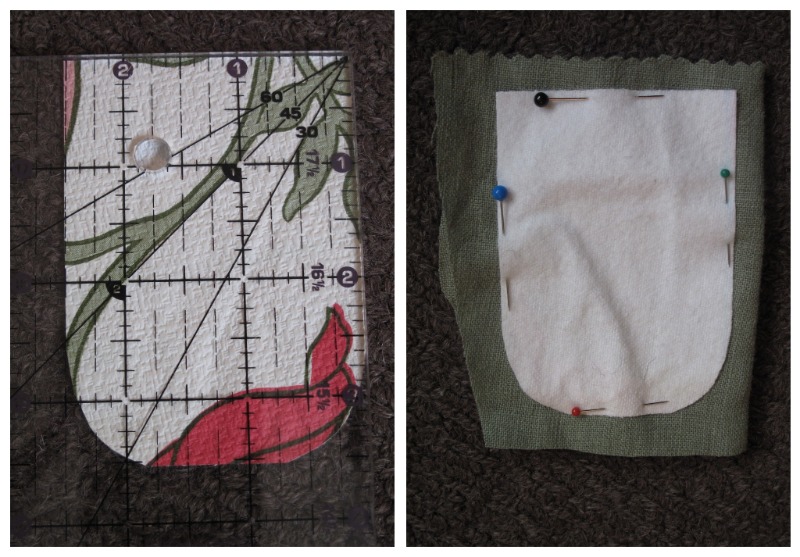
Cut out your tab.  Cut out one piece that each measure 2.5"x 3" from your main fabric.  You also want to round the corners on one side only (like in the picture).  As you can see, I cut out one piece floral table cloth, and then placed it right side down on top of a small scrap of green linen.  I often do this when I am sewing together two small pieces.  This way I don't have to be too concerned about getting them to line up precisely.  I sew first, and then trim them after to make them the same size.  This saves me a lot of frustration!

Pin your two pieces of fabric together inside of your seam allowance(I used my presser foot since that is the easiest, and that works out to a little more than 1/4").  Pins will leave holes in this type of fabric that don't go away, so be careful to pin only very close to the edge.

Sew your tab, using the edge of your presser foot as a guide.  After you are finished sewing your two pieces together, trim off the extra fabric using scissors or pinking shears.

Turn the tab inside out, and edge stitch all the way around.


Set your snap stud or sew on the hook side of your velcro to the rounded end of your tab.  The stud or the velcro should be sewn to the side of your tab with the coordinating fabric if you are using two different fabrics like I did.

Step 3 - Attaching your Fastener to the Mat

I designed this changing mat to fold into thirds, and then into thirds again.  To figure out where your snap socket or velcro loop tape needs to go, fold one of your two 21.5"x15.5" pieces in half and measure in 5" from one edge.  Mark this spot with a water soluble marker.

Now that you have marked the spot where you need to place your fastener, either sew your velcro, or place your snap socket over your mark.  If you are using snaps I would recommend sewing a small square of fabric (finished size: 1.5"x1") onto your vinyl first.  This will keep the snaps from pulling through your fabric.  
Sew the square over your mark.  My three year old is very helpful as you can see!
Now put in your snap socket in the center of your square.

Step 4 - Assemble Your Mat

Take the piece of fabric that does not have either a snap or velcro, and fold it in half the same way you did before.  Make a mark at the halfway point.  With the right sides of your fabric facing inwards, carefully pin all the way around your fabric.  Again, you want to be careful not to make any holes in your fabric.   You will need to leave a space to turn the mat inside out, so leave a gap around your mark like shown in the picture below.  I like to mark the start and finish point with two pins so I remember to stop sewing.
 
Starting and ending with your double pins, sew around the perimeter, using your presser foot as your guide.  Remember to back stitch when you start and finish sewing.

Step 5 - Sewing on the Tab

Turn your mat so that the right sides are facing out.   Fold your mat into thirds so that you have a long skinny rectangle and the hole that you used to turn your fabric right side out if at the top.  It should be near the snap (or velcro) we sewed on earlier.  Grab your tab and snap it onto the mat.  Now adjust how far it comes out of the gap, until things line up nicely.

Hold together carefully (or use a paperclip) because you don't want to make holes.  Sew your gap closed by edge stitching around the entire mat.


Step 6 - Mark Your Folding Lines

To help you remember how to fold things up, the next step is to sew two lines on top of the mat.  To do this, fold your mat in thirds like shown below.  Mark your stitch lines with painters tape.

Sew along the edge of the tape, remembering to back stitch when you start and stop sewing.


Step 7 - Finishing Touches

All that you have left to do is to pull off the painters tape and trim your threads.  Fold up your mat and it's ready to be used.


Congratulations, you are finished.  Now sit back and admire your new changing mat!  Now if only it was for something more fun than changing diapers...

Related Posts Plugin for WordPress, Blogger...